





Table of Contents
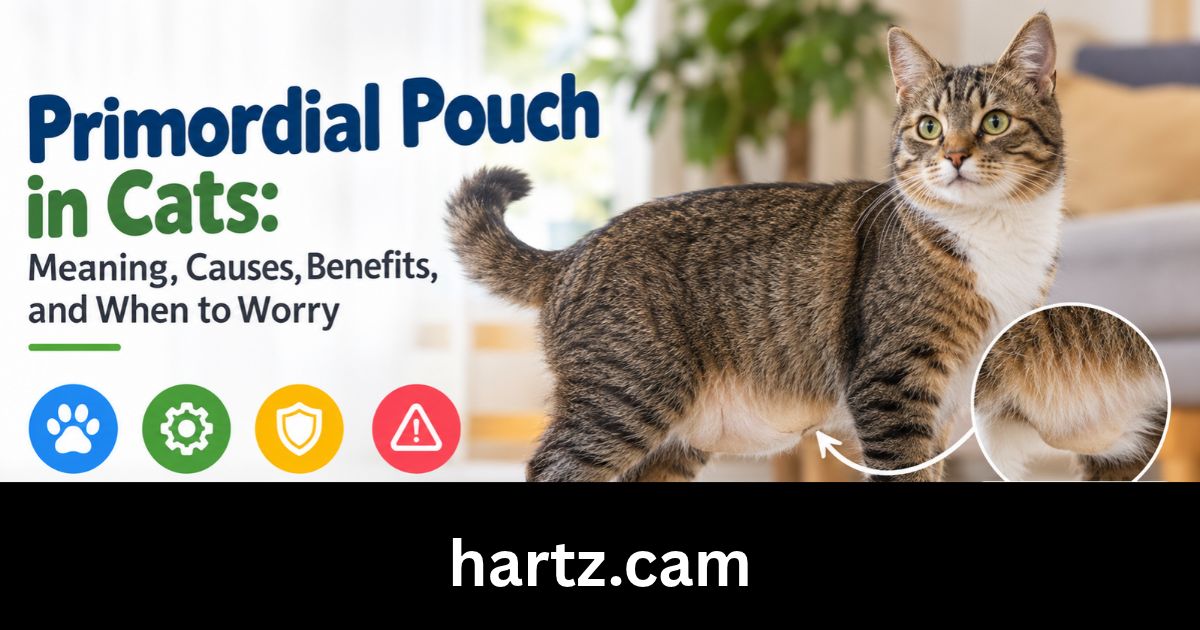
A primordial pouch is a loose flap of skin and tissue that hangs along the lower belly of a cat. It is a normal physical feature found in many domestic cats and wild feline species. Although some pet owners mistake it for excess fat or a sign of weight gain, a primordial pouch is often a natural part of feline anatomy.
Understanding the primordial pouch can help cat owners distinguish between normal body features and potential health problems. While this loose belly flap may provide several benefits, sudden swelling, unusual lumps, or changes in its appearance can sometimes indicate a medical issue that needs veterinary attention.
In this guide, we will explain what a primordial pouch is, why cats have one, which breeds commonly display it, how to distinguish it from excess body fat, and when you should consult a veterinarian.
What Is a Primordial Pouch?
A primordial pouch is a loose fold of skin, connective tissue, and some fat located along a cat’s lower abdomen. It usually becomes more noticeable near the hind legs and may sway from side to side when the cat walks or runs.
This feature is present in both male and female cats. It can appear in cats of different sizes, ages, and breeds, although its size and visibility vary between individuals.
The primordial pouch is not necessarily a sign that a cat is overweight. Even a healthy, lean cat can have a prominent pouch because the amount of loose skin differs naturally from one animal to another.
Why Is It Called a Primordial Pouch?
The term describes a natural anatomical feature that is believed to have developed through feline evolution. The word “primordial” refers to something associated with an early or original form.
Although the exact evolutionary purpose of the pouch is not fully established, researchers and veterinarians commonly discuss several possible functions, including allowing greater flexibility, providing some protection to the abdomen, and accommodating movement during running and jumping.
Why Do Cats Have a Primordial Pouch?
The primordial pouch may serve several purposes, although not every proposed function has been conclusively demonstrated.
1. Supporting Flexibility and Movement
Cats are naturally agile animals. They twist, stretch, leap, climb, and change direction quickly while playing or hunting.
The loose skin around the abdomen may allow the body to extend more freely during these movements. This flexibility can be particularly useful when a cat stretches its body to jump or reaches forward while running.
However, the primordial pouch is only one aspect of feline anatomy that supports movement. A cat’s muscles, joints, spine, and overall body structure also contribute to its impressive agility.
2. Providing Possible Protection
The lower abdomen contains important internal organs. Some experts suggest that the primordial pouch may offer a degree of protection by adding a loose layer of skin and tissue over this area.
Nevertheless, it should not be considered reliable protection against injuries, bites, or serious abdominal trauma. Cats can still suffer significant injuries even when they have a prominent primordial pouch.
3. Allowing the Abdomen to Expand
Another proposed function is that the loose skin allows the abdomen to expand during certain movements or after eating.
The pouch’s flexibility may accommodate changes in body position and abdominal shape without placing excessive tension on the skin.
Although this explanation is often mentioned, the extent to which the pouch specifically evolved for abdominal expansion remains uncertain.
4. Reflecting Feline Evolution
Primordial pouches are not exclusive to domestic cats. Similar loose abdominal skin can be observed in several wild feline species.
This resemblance has led to theories that the feature may have provided evolutionary advantages to feline ancestors. However, its precise historical origin and the relative importance of each proposed benefit are not fully understood.
Which Cats Have a Primordial Pouch?
Almost any domestic cat can develop a primordial pouch. Its appearance depends on factors such as genetics, age, body composition, and individual anatomy.
Domestic Shorthair and Domestic Longhair Cats
Domestic Shorthair and Domestic Longhair cats may both have noticeable primordial pouches. These cats have diverse genetic backgrounds, so the pouch can vary considerably in size and shape.
Some have a small fold that is barely visible, while others develop a more pronounced flap along the lower abdomen.
Bengal Cats
Bengal cats are known for their athletic bodies and distinctive spotted or marbled coats. Some Bengals have a visible primordial pouch, which may become apparent as they mature.
However, the presence or size of a pouch is not a reliable measure of whether a Bengal cat is purebred or healthy.
Egyptian Mau Cats
Egyptian Maus are athletic cats recognized for their naturally spotted coats. Some individuals have loose skin around the abdomen that contributes to their flexibility.
As with other breeds, the size of the primordial pouch varies among individual Egyptian Maus.
Sphynx Cats
Sphynx cats have little or no fur, making their skin folds easier to see. A primordial pouch may therefore appear particularly noticeable in this breed.
The lack of a thick coat does not mean that the pouch is abnormal. Owners should simply monitor the skin for irritation, redness, or other changes.
Other Cat Breeds
Breeds such as the Maine Coon, American Shorthair, and many mixed-breed cats can also have primordial pouches.
No specific breed needs to have a large pouch for a cat to be considered healthy. Individual variation is normal.
Primordial vs. Belly Fat: How to Tell the Difference
One of the most common concerns among cat owners is whether a hanging belly means their cat is overweight.
A primordial pouch and excess body fat are different things, although they can occur together.
Signs of a Normal Primordial
A typical primordial pouch has the following characteristics:
- It consists of loose, soft skin along the lower abdomen.
- It often swings gently when the cat walks.
- It may be more noticeable when the cat runs or stretches.
- It generally does not cause pain when the cat moves normally.
- Its presence does not necessarily affect the cat’s activity level.
A healthy cat can have a prominent primordial even when its overall body condition is appropriate.
Signs of Excess Body Fat
An overweight cat may have a rounded abdomen, but excess weight often affects more than the lower belly.
Possible signs include:
- Ribs that are difficult to feel beneath the fat.
- A less visible waist when viewed from above.
- Fat deposits around the back, hips, and abdomen.
- Reduced willingness to jump, run, or play.
- Difficulty grooming certain parts of the body.
A veterinarian can assess your cat’s body condition and determine whether its weight is appropriate.
Can a Cat Have Both?
Yes. A cat can have a normal primordial and still carry excess body fat.
The presence of a pouch should not be used as the only method of assessing weight. Instead, consider the cat’s overall body shape, activity, muscle condition, and weight history.
If you are unsure whether your cat is overweight, ask your veterinarian to perform a body condition assessment.
When Does a Primordial Pouch Develop?
The timing varies between cats. Some have a noticeable abdominal flap when they are relatively young, while others develop a more prominent pouch as they mature.
Age and Development
A primordial pouch may become more visible as a kitten grows into an adult cat. Changes in body proportions and skin elasticity can affect how the pouch looks.
Older cats may also experience changes in skin firmness and muscle mass, making loose skin more noticeable.
However, a newly enlarged abdomen in a senior cat should not automatically be attributed to aging.
Genetics and Individual Differences
Genetics can influence the size and appearance of a primordial pouch. Even cats from the same litter may have different amounts of loose abdominal skin.
Some cats naturally have a small fold, while others have a larger one. Neither appearance automatically indicates a health problem.
Spaying and Neutering
Some owners notice a more prominent belly after their cats are spayed or neutered.
These procedures can coincide with changes in activity levels, appetite, and energy requirements. If a cat consumes more calories than it uses, it may gain weight, making its abdomen appear larger.
However, spaying or neutering does not automatically cause a primordial pouch, and a visible pouch alone is not proof of weight gain.
Can You Prevent or Remove a Primordial Pouch?
A natural primordial pouch does not require treatment or removal. It is a normal anatomical feature rather than a disease.
Can Exercise Make It Disappear?
Exercise can help a cat maintain a healthy weight, but it will not necessarily eliminate loose skin.
Encourage regular play with suitable toys, climbing opportunities, and activities that stimulate natural hunting behaviors. Short, frequent play sessions may be easier for many cats than one long session.
The goal should be to maintain good health and mobility, not to make a normal primordial pouch disappear.
Can a Special Diet Reduce It?
A balanced diet can help manage excess body fat, but food cannot selectively remove loose skin from the abdomen.
If your cat is overweight, a veterinarian can recommend an appropriate calorie intake and feeding plan. Weight loss should be gradual because rapid weight loss can be dangerous for cats.
Avoid crash diets, extreme food restrictions, or unverified weight-loss products.
Is Surgery Necessary?
Surgery is generally unnecessary for a normal primordial pouch.
If the abdominal area becomes unusually enlarged, painful, firm, or asymmetric, a veterinarian should examine the cat before any treatment is considered. The cause may be unrelated to a primordial pouch and could require medical care.
Surgical removal of normal loose skin is not a routine veterinary recommendation.
When Should You Worry About Your Cat’s Belly?
Although a primordial pouch is usually harmless, not every change in a cat’s abdomen is normal.
A new or rapidly enlarging belly should be evaluated rather than automatically identified as a primordial pouch.
Warning Signs to Watch For
Contact a veterinarian if you notice:
- Sudden enlargement of the abdomen.
- A hard, tense, or painful belly.
- A distinct lump or swelling that was not previously present.
- Redness, wounds, discharge, or unusual skin changes.
- Persistent vomiting, loss of appetite, or unusual tiredness.
- Difficulty walking, jumping, urinating, or defecating.
- Unexplained weight loss alongside abdominal enlargement.
These symptoms may have several possible causes, including injury, a hernia, fluid accumulation, digestive problems, or other medical conditions.
A veterinarian may need to examine the abdomen and, depending on the findings, recommend blood tests or diagnostic imaging.
Seek emergency veterinary care if your cat has sudden abdominal swelling accompanied by severe pain, difficulty breathing, collapse, or marked weakness.
How to Monitor Your Cat’s Primordial Pouch
Check your cat’s abdomen periodically during normal grooming or handling. Look for changes in size, shape, skin condition, and sensitivity.
Avoid repeatedly squeezing or pressing the area. If your cat reacts painfully, stop handling it and arrange a veterinary assessment.
Maintaining a healthy weight, providing a balanced diet, and attending routine veterinary checkups are useful ways to support your cat’s overall well-being.
Frequently Asked Questions About the Primordial Pouch
1. Is a primordial pouch normal in cats?
Yes. A primordial pouch is a normal anatomical feature in domestic cats. It consists of loose skin and tissue along the lower abdomen and does not automatically indicate obesity or illness.
2. Do all cats have a primordial pouch?
Not all cats have an equally visible pouch. Some have a prominent abdominal flap, while others have very little noticeable loose skin. Both appearances can be normal.
3. Does a large primordial pouch mean my cat is overweight?
No. A large pouch alone cannot determine whether a cat is overweight. Veterinarians assess overall body shape, fat distribution, muscle condition, and weight to evaluate a cat’s health.
4. Can a primordial pouch disappear naturally?
Its appearance may change as a cat matures or its body composition changes. However, loose skin may remain even when a cat is lean. There is no guarantee that a natural pouch will disappear.
5. Do male cats have primordial pouches?
Yes. Both male and female cats can develop primordial pouches. The size of the pouch varies between individuals and is not determined solely by sex.
6. Why does my cat’s primordial pouch swing when walking?
The loose skin and tissue allow the lower abdominal area to move as the cat walks, runs, and jumps. This movement is usually normal when the pouch is soft and does not cause discomfort.
7. When should I take my cat to the veterinarian?
Arrange a veterinary examination if the abdomen suddenly enlarges, becomes painful or firm, develops a distinct lump, or changes alongside symptoms such as vomiting, weakness, or reduced appetite. Severe or sudden symptoms may require emergency care.
Conclusion
The primordial pouch is a common and generally harmless feature of feline anatomy. This loose fold of skin and tissue appears along the lower abdomen and can be found in cats of many breeds, ages, and body types.
Although flexibility and protection are frequently suggested as possible benefits, the precise functions of the primordial pouch are not fully established. Its size also varies naturally, so a prominent pouch does not necessarily mean that a cat is overweight.
The most important step is to understand your cat’s normal body shape and monitor any changes. Maintain a balanced diet, encourage regular physical activity, and arrange routine veterinary checkups to support long-term health.
If your cat develops sudden abdominal swelling, pain, a firm lump, or other unusual symptoms, consult a veterinarian instead of assuming the change is simply a primordial pouch. Recognizing the difference between normal anatomy and a potential medical concern can help you keep your feline companion healthy and comfortable.